Marshall Studio Vintage SV20H MKII Amplifier Head
09/04/2026
Beginnings... literally
Back around 1970 Electro-Harmonix began using the phrase, “Like unto a stack of Marshalls,” to describe the sound of their LPB-1 booster, and it is a promise that has been made and broken many, many times over the years. Those who use the phrase are referring to Marshall’s Model 1959 (100 watt) and Model 1987 (50 watt) amplifiers, known as “Plexis” due to the gold Plexiglas control panels the early ones sported. These amps are the source of many, many of the classic rock tones we love. I know that my interest in those models started in 1973 when a friend dropped off the Allman Brothers' Beginnings album for me to listen to.

The music was revolutionary and their guitars were powerful. The front cover photo was taken during one of the Allman Brothers' nights at the Fillmore East in 1971 and just look at all those Marshall amplifiers!!! Their Live At Fillmore East album made me want a Marshall amp... really badly. Now, I understand that most people look at the jumble of black boxes in the backline of rock bands with a jaundiced eye, but they've always held a great fascination for me. That's where the sound comes from! As we waited for concerts to begin, the amplifiers' pilot lights stared at us and hinted of the music to come. Many, many artists of the period used the Marshal Plexi models to create their signature sounds, which went on to become some of the foundational guitar sounds of Rock & Roll. Clapton, Hendrix, Page, Beck, Trower, Allman, Betts, Walsh, Rossington, Collins, Box, Scholz, Johnson... Of interest to me, each of those guys had his own sound but the foundation was the same amp brand.
 Then when I was in high school, a friend of mine invited me over to jam. He played his Les Paul Junior through a Marshall 1987 amp and a monstrous Model 2034 8x10” speaker cabinet and WOW! he got the classic, aggressive sound of rock. His amp simply blew away my little Silvertone, both in loudness and in that sound. That experience was an eye-opener. I saw his band play a couple of times and I’ll admit that I was one jealous sixteen-year-old. I'm sure this contributed to my fascination with Marshall Plexis. But those big old amps were and are LOUD. Really loud. They are also heavy monsters, created for the big venues back in a time when the P.A. systems couldn't support the guitarists so they relied on big guitar amps to fill the hall. My friend and his band had bought an old Cadillac hearse just to haul the amps. I’ve heard those amps played in smaller clubs and they were absolutely deafening. Beautiful, but deafening. Since then, the world of live performance has changed. Guitar amps are now miked and sent through better P.A. systems, so the size and loudness of these amps are no longer needed. These days, while many guitarists are dying to achieve the classic Marshall sounds, they also want quieter amps. Many amp companies have promised to deliver this combination but few have, so that combination became the holy grail for many guitarists.
Breakthrough
But in 2019, after many years of thrashing around creating other attempts that nearly gave you the classic Marshall sound, Marshall released a group of amps called the Studio Series that coupled the preamps of the historic Marshall amps from five eras with newly designed, 20-watt cathode bias power amps voiced to recreate those classic Marshall amps at a lower levels than the originals. There are five amps and eras reproduced: the JTM45 "Bluesbreaker", the 1959 Plexi, the JCM800, the JCM900, and the Silver Jubilee. These models also span a gain continuum from low-medium to extremely high gain and are offered in both head and combo models with matching extension cabinets, all clad in the livery of their respective eras.

At home
THE ITEM IN QUESTION
The model that caught my ear was the "Studio Vintage" SV20H MKII head, the second step up Marshall's gain continuum. I suppose this is no surprise because this model recreates the venerable Model 1959 Super Lead 100 watt amp that was released in 1965 and was featured on so many of my 1970s albums and at concerts. But this new version is also executed in miniature, like a Model 1959 left in the dryer too long, and I am a sucker for anything miniature.
This is my third attempt to capture the Marshall sound that lives in my head... but in manageable form. I’ve owned a JTM60 for thirty years and still use it for clean sounds because its distorted channel was created with a blend of tubes and diodes and has the buzzy, fizzy sound that diodes impart. Then I was given a JMP-1 preamp. Its sound is closer to the mark, but its distortion is still fueled with a blend of tubes and diodes like the 1980s Marshalls. More recently, I acquired a Marshall Origin 20 combo. That amp’s sound is driven entirely with tubes but there is a bit of sharpness to it and the gain is a little lower than that of the later Plexi amps. In the final analysis it seems to emulate the earliest, JTM45 stage of the Marshall evolution. All of these amps and preamps came close in some ways but yielded no cigar. Then I read some very favorable talk on Internet forums that the Studio Series had finally nailed the real Marshall Plexi sound. At that point I began my research in earnest to learn more about this newer series and to see which one might best work for me. I soon zoomed in on the SV20H MKII.
Right about the time my research was really becoming serious, the Fourth of July sales at guitar stores started popping up. As usual for the Fourth, my local Guitar Center offered a 15% discount off the price of a new item if you traded something in... and they had one of the SV20H heads in stock. I started up a spreadsheet and began looking at some of my gear candidates for trade. My practice is to go on the Guitar Center site itself, find the price that THEY are reselling items like mine for, and calculate 60% of that (their best trade rate) to find my trade items’ value in the transaction. I was able to put together a trade that I estimated would hit my out-of-pocket price goal. I loaded up the gear, put the spreadsheet on my iPhone, and headed down to the store. It took the guys at the front counter a little cheerful hemming and hawing and research, but in the end they saw that I’d done my homework so their final price offer ended up only $20 off my target. Not bad, and SOLD.

SO, WOT'S IT ALL ABOUT, HAROLD?
The Marshall SV20H is a no-master-control, two channel, twenty-watt amplifier with the two channels voiced quite differently and a power reduction circuit that brings the output down to five watts. All of this is housed in the familiar “bread box” early Marshall amp style head box with a gold Plexiglas “letter slot” control panel down front and center. The box is covered in black levant Tolex with sharp gold piping and hardware and features bright brass vent screens on top and out back. The two channels are a “Normal” channel that is relatively dark, and a “High Treble” channel that surprise! is quite bright. Each channel offers both a high and low gain input (high on top) and the two channels share a single three-band EQ. There is also a Presence control that regulates upper end response in the power amp. That makes it is a fairly simple amp. The power section is driven by two EL34 tubes in a cathode bias scheme and the preamp uses three ECC83/12AX7 tubes. The down-powered EL34s help give the amp a more robust sound than you could expect from their little brother, the EL-84.

Wot's inside, Harold?
The majority of the amp’s circuitry is built onto a single, large circuit board, with most of the front and rear controls and connections residing on two smaller boards. There are no ribbon connectors. Instead, individual wires bridge between the boards. A unique feature of the early Marshall amplifiers is the ability to plug a jumper cable between the two input channels and use their two Loudness controls to blend their sounds to taste. This amp follows that scheme. When jumpered, the three controls that affect treble allow lots of control over the quality and amount of treble in your sound.

On the back panel there are sixteen, eight, and four-ohm speaker outputs as well as an emulated direct out and a loop with a chassis-mounted bypass switch. Though Marshall doesn’t shrink from using the latest tech in building the amp, there is still a lot of handwork involved, especially in the cabinetry. The Studio Series was designed and is built in Bletchley, Milton Keynes, U.K., the location where the British codebreaking organization was headquartered in World War II. The Marshall company moved there from their original location in West London in 1967.
TEST FLIGHTS
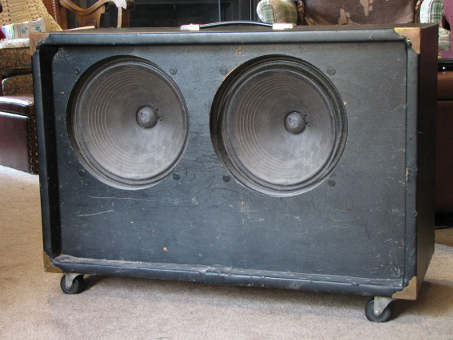
I’ll be mating this amp with a 2x12” ported cabinet that my father and I cut down from a 1930s Hammond Tone Cabinet some fifty years ago, so that is what I’ve used for my demos. It is an unusually deep cab that we ported in the rear, giving it great bass range. The two speakers in it are re-coned pulls from mid-1960s Fender amps: a Jensen C12NA and a Utah. Over time I’ve discovered that I prefer American speakers over Celestions with Marshall amps. Their smoother, more rounded sound makes Marshalls a little gentler to my ears than the pinched midrange of the Celestions. Open cabinets are also a tad more gentle than closed-back cabinets as well, and that is my preference. More about the cab,
HERE
 Once the channels are jumpered you can set the basic loudness of the amp with the Normal channel and then bring up the Bright channel to set the overall brightness. Most of the demo people I've seen on YouTube have run the Treble control, the Presence, and the Loudness of the High Treble channel, all quite high. In fact, some have used only the High Treble channel. While that is gratifying in a “hair on fire” sort of way, I've found myself wanting to control some of the insect-attracting high frequency overtones by pulling back a little on those controls. Perhaps I learned that from Jeff Beck and Andrew Latimer of Camel, whose Marshall tones ended up quite smooth and round. It could be that I learned it from Joe Walsh, who often takes a raucous sound and achieves something beautiful with it. You can fiddle around with the jumpering if you like – making either the High Treble or Normal channel input the one that you plug the guitar into and switching the jumpers accordingly. Each iteration offers a slightly different sound. Make your own choice! It’s more down to your own taste than institutionally-established standards or magic. I settled into plugging the guitar into the High Treble High Gain input then patching the low gain input from that channel into the high gain input of the Normal channel. It works fine for my needs. Oh, and by the way, I ordered a three pack of MXR three-inch ribbon jumper cables from Amazon, HERE, that are pefect for the job. You can see one in the pic above.
AND THE SOUND...
With a Les Paul and a little understanding and taste, the various classic shades of Marshall Plexi semi-clean and distortion jump out effortlessly on command. Gloriosky! There it is! This is the real thing: the real Marshall crunch and lead sounds like the original Plexis. It is bold and full and not thin at all. Like the originals, the amp offers medium gain, and when most people think of a Plexi that is what they think of. To find that gain, you plug into the high gain inputs and turn up the Loudness to find that you smoothly enter distortion by nine or ten o’clock on the dials. Despite being a solid-state rectified amp, there is amazing, effortless sustain and compression available from it. Because the original 1959 Plexis have five times the power of this Studio Series version, you do get more bottom end and more thrust in the chest from them, but those characteristics will probably be lost in the mix in either a P.A. or recording situation. This amp is the easiest to manage with the guitar's volume controls of any I've played through. Controlling things using the guitar’s volume control was the way we used to do it: you’d set your lead sound and level with the guitar's volume control wide open and then pull back. Part the way down brings you to your crunch sound. A little further and you are clean. With this amp we are taking about a clean sound without undue loss of high-end. Nice! That is the glory of the non-master control amp that is often lost, to one degree or another, when you add that master volume control.

The power reduction feature is quite useful, bringing down the power from twenty watts to five watts, which is closer to bedroom level. It does so without reducing the bass too much. I did say closer to bedroom level. Frankly, in five-watt mode it is still darned loud. Little five watt practice amps will irradiate you; this one will push you right out the bedroom door. In numbers, with the volume controls around eleven o'clock, we are talking about 110db in twenty-watt mode and 100db in five-watt mode when measured with the Decibel X iPhone app at two feet in front of the amp. Because of the loudness I have finally invested in an attenuator, a Weber MASS 200, to protect my hearing and my neighbors'. It easily knocks down the sound pressure level by another ten db. And let me promise you that I did my measurements with the ear plugs IN. You can read about the Mass 200, HERE. The onboard power reduction on the SV20H is controlled by a three-way switch with the center position being “Standby”. Also curiously for Americans, the power switch follows the British pattern with down being “ON”.
NECESSITY IS THE MOTHER OF STRANGE BEDFELLOWS
During one of my demo sessions I wanted to play the amp late in the evening but I needed to do it without disturbing my wife or the neighbors. By then I knew that the amp was pretty loud, so I switched to five-watt mode and plugged up the ES-335. I did give the amp a quick spin at distorted gain levels and then backed off the Loudness to the low end of the range and tried out some clean sounds. Now here was a real surprise: The amp responded very nicely with a smooth, bright, clean sound. You know how some amps want to go “thunk, thunk, thunk” at lower levels? This one has a very pretty clean sound, still compressing the transients a bit and yielding a very nice sustain from the instrument. I believe that this might be a fundamental characteristic of the preamp’s design. I plugged around to the low gain input on the normal channel and, lo and behold, it just became sweeter without losing sustain. Amazing! After all the talk of Marshalls not being useful for anything except grind, this was a real revelation. Now, all of this was done while the channels were jumpered. I pulled back the High Treble channel significantly from the level of the normal channel and backed off the Treble control a bit as well. After playing around with all the treble options, there were many sweet options.
ADDING THE PEDAL TO THE METAL
Everyone asks: "How does it take pedals?" For this review I tried a bunch of boosts and drives in front of the amp to see how it took them. I started with a decent crunch sound dialed in on the amp.
- We'll start with the Nobels ODR MINI. I set the level at about ten o'clock, the drive quite low, and the Spectrum in the middle so that the insertion level was just above unity. Ahh, you could feel the front end of the amp being "cooked" and the resultant bloom of overtones, compression, and smoothness. It basically acted like a "MORE" box, embiggening and adding more of the amp's own sound. Any increase in level or drive mostly increased sustain. Twisting the Spectrum control one way or the other simply adjusted the amount of bass and treble in the sound.
- I moved on to the Tube Screamer varieties via the JHS BONSAI, a component-by-component recreation of nine versions of the Tube Screamer. The Maxon OD-1 repro acted as a "more" pedal but offered no treble control. The classic TS-9 repro added the mid boost and bottom end clean-up that most players are familiar with. Once again, it was a "more" pedal. The Screamer with the JHS Strong Mod was fuller, cleaner, and stronger than the rest and was my favorite. I have to say that I preferred the ODR Mini to the Screamers. It was just more transparent than them.
- Next I tried the ANALOG ALIEN JOE WALSH DOUBLE CLASSIC, a combination compressor and amp sim. The nice onboard compressor introduced some subtle sustain and its gain makeup allowed me to cook the front end of the amp to get "more" of its own sound. The amp sim added gain and allowed some subtle tone control as well but I really found it to be unnecessary. It could, however, be used for an "unboost" for crunch sounds.
- One I really wanted to try was the MXR MICRO AMP PLUS, which is a modern update to the classic MXR Micro Amp, a clean boost. With the redesign it is a very, very clean boost indeed, and once again it is something of a MORE pedal. I really like how it increased the overtones and sustain and smoothed out the sound.
- I also tried an MXR Carbon Copy analog delay, a Catalinbread Belle Epoch Echoplex EP-3 simulator, and a Neunaber Stereo Wet Reverb between the guitar and the amp. All functioned as expected. The Carbon Copy sort of hides smoothly and subtly in the background, as expected. The Belle Epoch is more pronounced and can be played like an instrument. The Stereo Wet was dropped in and did its job, offering a nice reverb. None of the modulation pedals caused problems with gain or major tone changes.
Overall, I was struck by how much the amp held its basic sound with the drives and boosts and how all the pedals I used just gave me more of what the amp had to offer.
SIDE-BY-SIDE AMP COMPARISONS
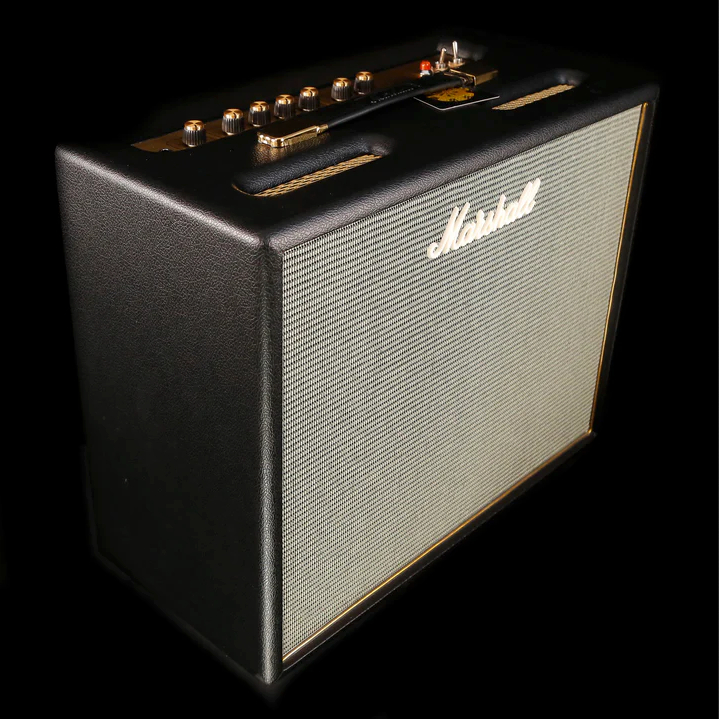
Because I bought and reviewed the Marshall Origin 20C last year (and you can find that review
HERE), I'm going to compare the two amps. I figure I owe you that, since I was fairly pleased with the Origin 20 but eventually went hunting for something closer to the Marshall sound in my head. For the comparison, they will both first be plugged into the same Hammond 2x12" cabinet and then I'll also compare them with the Origin 20C through its onboard 10" Celestion G10 VT Jr. speaker. When both are listened to through the Hammond cab, the SV20H’s sound is much more err…
robust, or perhaps
muscular than the Origin 20C. The mids and bass of the SV20H are much fuller when compared to those of the Origin. The Origin’s highs sound more “spikey”. Its distortion is "razzier", for lack of a better term, than that of the SV20H as well, and there is less gain available. Even with a humbucker-equipped guitar, you need to crank up the Origin's Master and Gain controls pretty far, say both to three or four o’clock-ish, to push into a pleasant crunch, even with hot humbuckers. There is also less sustain available from the Origin than from the SV20H. Now here is an interesting tidbit: While the Origin 20 uses a three-position "Powerstem" circuit that lowers the power by altering the screeen voltage on the EL-34s, the SV20H does so by lowering the
plate voltage. As a result, the SV20H has a more useful low power range that doesn't cut the bottom end as much as the Origin does. The Origin
can be be operated quite a bit more quiet than the SV20H when you set it to its lower Powerstem setting. Perhaps Marshall saw the Origin 20 line as its all-tube
bedroom solution and avoided that capability on their the SV20H. I find it far easier to dial in the sounds I like with the SV20H and control the sounds from the guitar's volume controls. Of course, we are talking about a non-master-volume amp in the SV20H and an amp with an entrace fee that is a little more than
twice that of its Origin 20H head brother, so I still consider the Origin 20 combo to be a fine bargain at its price and a great grab-and-go, single-box Marshall solution.

And, because my Fender '65 Blackface Deluxe Reverb Reissue is sitting right here, let’s compare it to the SV20H as well. The DRRI is considered a pretty bright Fender amp, especially its Vibrato channel, but the SV20C amp has the capability to be a whole league brighter still. Even with hot humbuckers and the amp set up past 12 o’clock, the DRRI somewhat reluctantly enters into distortion at about the same point as the bright cap begins to lose effect. The Deluxe also has a rounder, boxier sound overall and exhibits the classic Fender jump from way to quiet to too loud in a hair's breadth on the volume control. By contrast, the SV20H eases its way up and then gently enters into distortion at about 10 o’clock on the dials where there’s still plenty of high-end on tap. I've seen comments that some consider the taper of the Marshall bright cap too bright but I find it easy to moderate with the controls and useful at lower levels. Of course, it comes down to horses for courses: you need to decide how much upper-end versus girth that you want.
MISCELLANEOUS ODDITES
Something funny from the unboxing: inside the main box, the amp is packed with a small box at its side with the box's top end marked "Open". It has a little finger opening to allow you to pull it out of the main box. When you pull it out, you find out that it has no bottom, and everything it contains falls right out. Unique. Strange.
Something interesting from the unboxing: the amp's manual is a glossy 4x6 with a color front page, just like the days of old. By way of contrast, the Origin 20 came with a fold-out monochrome sheet instead. I guess it is a little touch that goes with the amp having been built in England.

Marshall Studio Vintage SV20H MKII
CONCLUSIONS
So, has Marshall really pulled this one off? I would say absolutely "YES", and in spades. After years of wishing for a Plexi in a reduced size, weight, and loudness, I’ve finally found one. It naturally and easily offers the Marshall sound that I’ve been searching for and is everything I had hoped it would be. The sound and the build are both impressive. The visual aesthetic is as attractive as the sound the amp offers as well. At a little more than one-third the price of a Model 1959 reissue, the price tag is entirely reasonable for the product, given that it is hand-built in England.

SPECIFICATIONS
Output Power:20W (5W setting)
Preamp Tubes: 3 x 12AX7
Power Tubes: 2 x EL34
EQ: 3-band EQ
Inputs: 2 x 1/4" (high, low treble input), 2 x 1/4" (high, low normal input)
Outputs: 1 x 1/4" (16 ohm), 2 x 1/4" (single 8 ohm or 2 x 16 ohm), 2 x /14" (single 4 ohm or 2 x 8 ohm), 1 x 1/4" (DI out)
Effects Loop: Yes
Bias Type: Cathode Biased
Construction Material: Black Tolex
Power Source: Standard IEC AC cable
Height: 9.4"
Width: 19.7"
Depth: 9.1"
Weight: 20.4 lbs.
WHAT'S IN THE BOX?
SV20H Amplifier
IEC Power Cord
1/4” Speaker Cord
Instruction Booklet
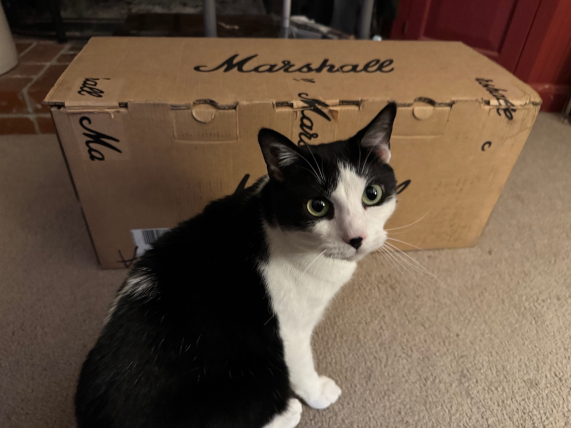
Oscar says, “When you gonna open this thing?”

MARSHALL SV20H WEBPAGE
= =
=
